Block Storage Price Comparison: Traditional Cloud (gp3/io2 style) vs ABS
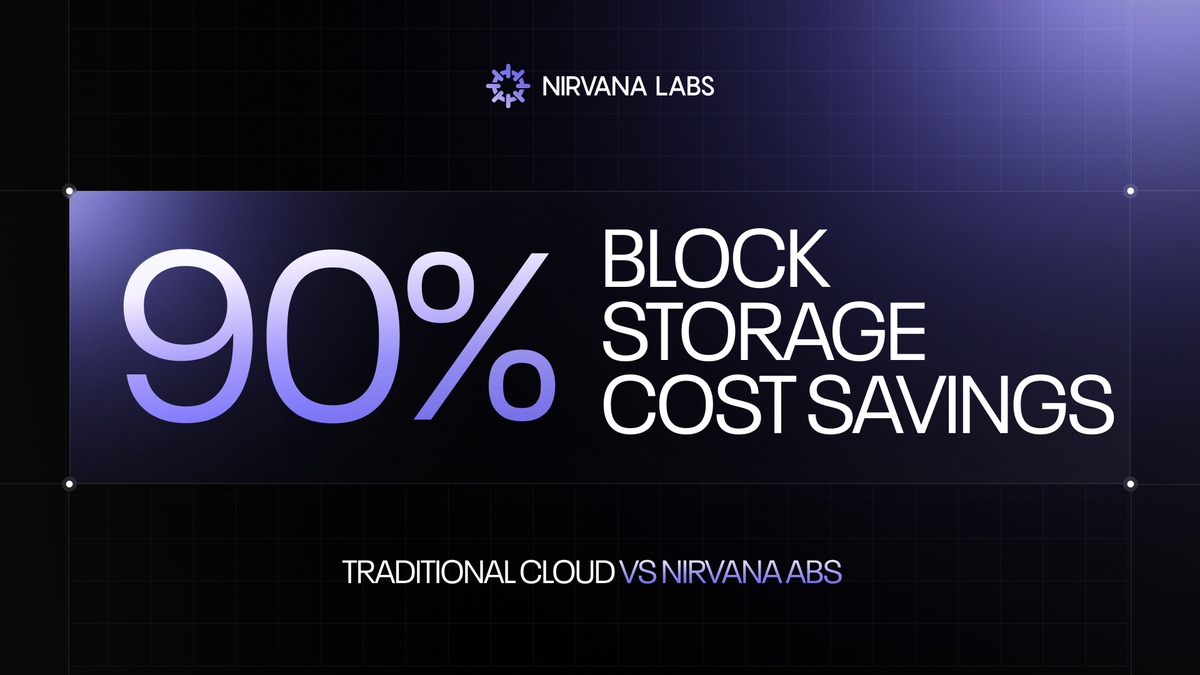
Save up to 90%+ on io2 with ABS
If you’ve built on traditional cloud block storage long enough, this will feel familiar:
Pricing looks reasonable at first glance. Then you realise storage isn’t just storage - it’s IOPS, latency, and throughput, all priced separately.
That’s when the bill starts to grow.
When your workload demands real-world performance, you are forced to choose between complex volume stacking or expensive high tier upgrades.
ABS is built for teams already running on traditional cloud block storage who want better performance without higher bills.
Rather than inventing scenarios, let’s use public pricing examples commonly used to explain traditional block storage costs - and compare them directly.
Using Traditional Cloud Examples for a Fair Comparison
These examples are useful because they make one thing very clear: storage pricing starts with capacity, but real performance is always an add-on.
For consistency, all costs in this comparison are normalized to a 1 TB monthly equivalent.
Scenario Comparison: Traditional Cloud vs ABS
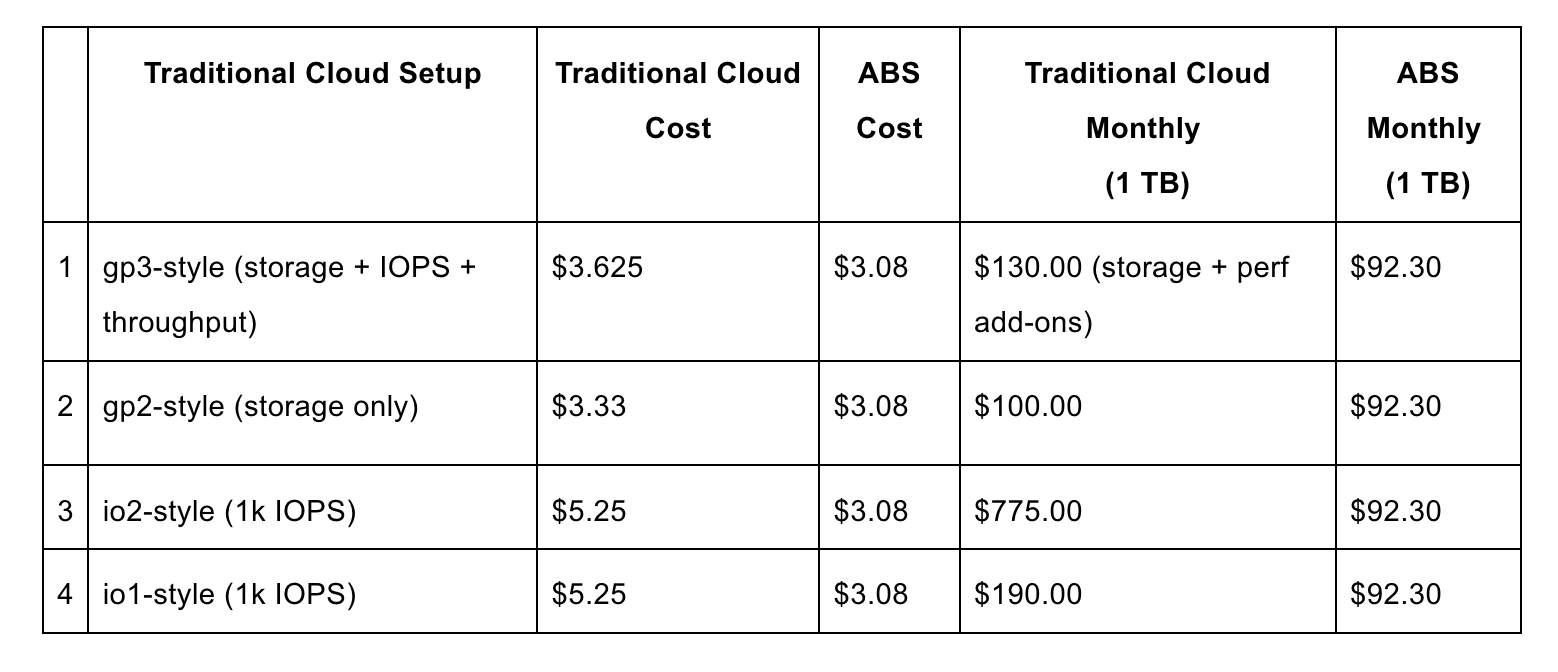
Source: https://aws.amazon.com/ebs/pricing/
Note: Savings are most pronounced for workloads using io2-class storage for sustained IOPS. In these cases, unlocking performance often requires higher-tier Nitro instances, adding ~$250–$500+/month per node in compute costs. For gp3-level workloads, differences are smaller. On Nirvana, equivalent compute is ~$100/month, with storage performance included.Cost Comparison: io2 vs ABS (Sustained IOPS)
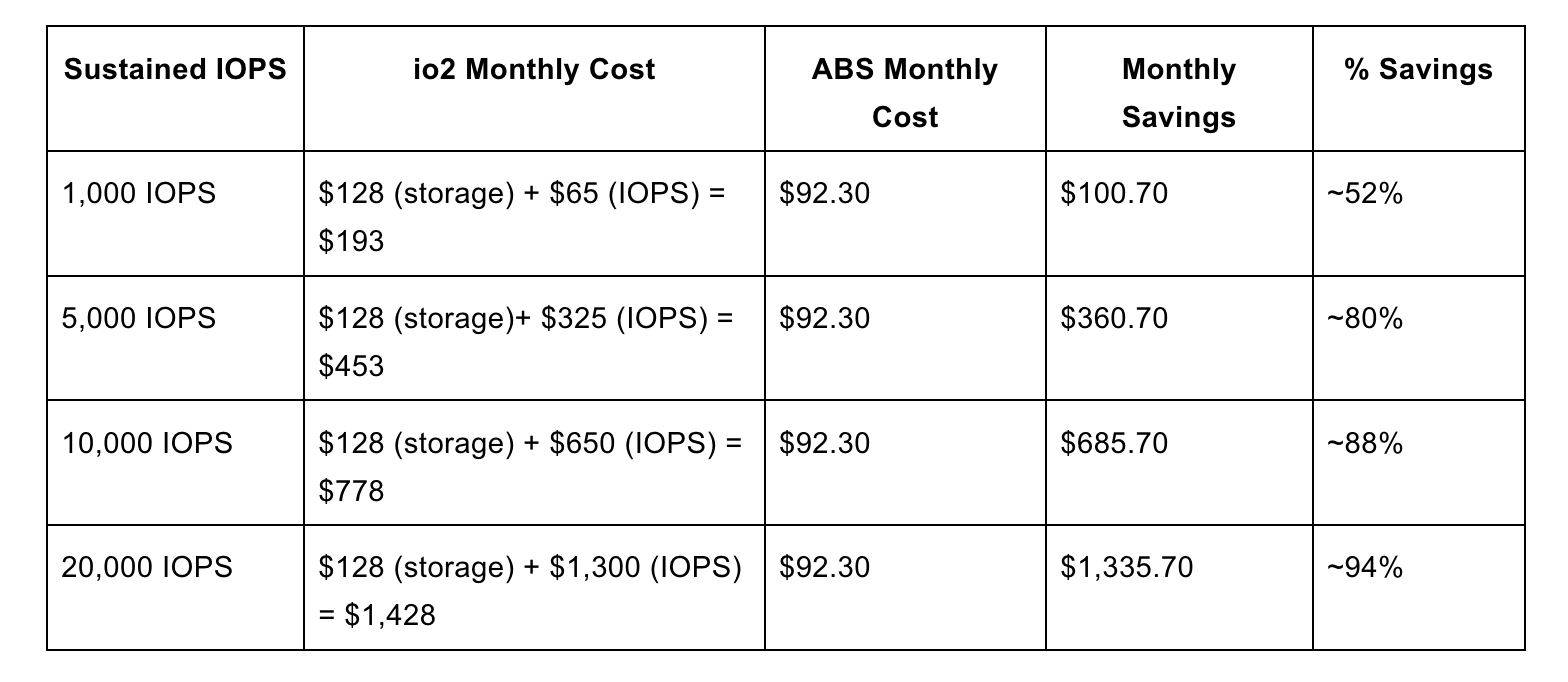
Cost Comparison: io2 vs ABS (Sustained IOPS)
If you’re using io2 and looking for sustained IOPS under 20,000, here’s how much you can save. Assumptions:
- 1 TB = 1,024 GB
- Sustained IOPS ≤ 20K → all IOPS fall in the $0.065 tier
- Monthly pricing (no proration)
With traditional cloud block storage, capacity and performance are priced separately. Capacity is just the starting point - predictable IOPS and throughput arrive later as paid add-ons or higher-tier volume upgrades, often governed by burst credits and throttling behavior.
ABS takes a different approach. We start with a high-performance baseline and don’t let it degrade over time, delivering sustained performance without throttling, a 20,000 IOPS baseline with burst capacity up to 600K IOPS, and 1.5–3 ms latency—with sub-millisecond latency achievable via node-level colocation. ABS scales elastically from 32 GB to 4 PB+, with zero-downtime scaling and recovery built in.
If you’re tuning storage settings just to keep latency under control, you’re paying a performance tax.ABS removes it.
Want to see how this looks for your workload?
Get in touch.
Nirvana: Modern Cloud for Real-time Workloads
High Clock Speeds Compute. Low latency Storage. Radically Cheaper Bandwidth.
Powering Web3, AI, and real-time systems.
Learn more at Nirvana Labs
Nirvana Cloud| Pricing | Blog | Docs | Twitter | Telegram | LinkedIn