Nirvana Accelerated Block Storage (ABS) is Live

Sustained IOPS block storage built for real-time workloads
Nirvana Accelerated Block Storage (ABS) is officially live.
ABS is a high-performance block storage layer designed for modern, latency-sensitive systems. It delivers sustained IOPS, low latency, and predictable throughput under continuous load, without relying on burst credits or performance add-ons.
As part of the Nirvana Cloud, ABS completes a tightly integrated compute, storage, and networking stack built from the ground up for real-time execution.
TL;DR
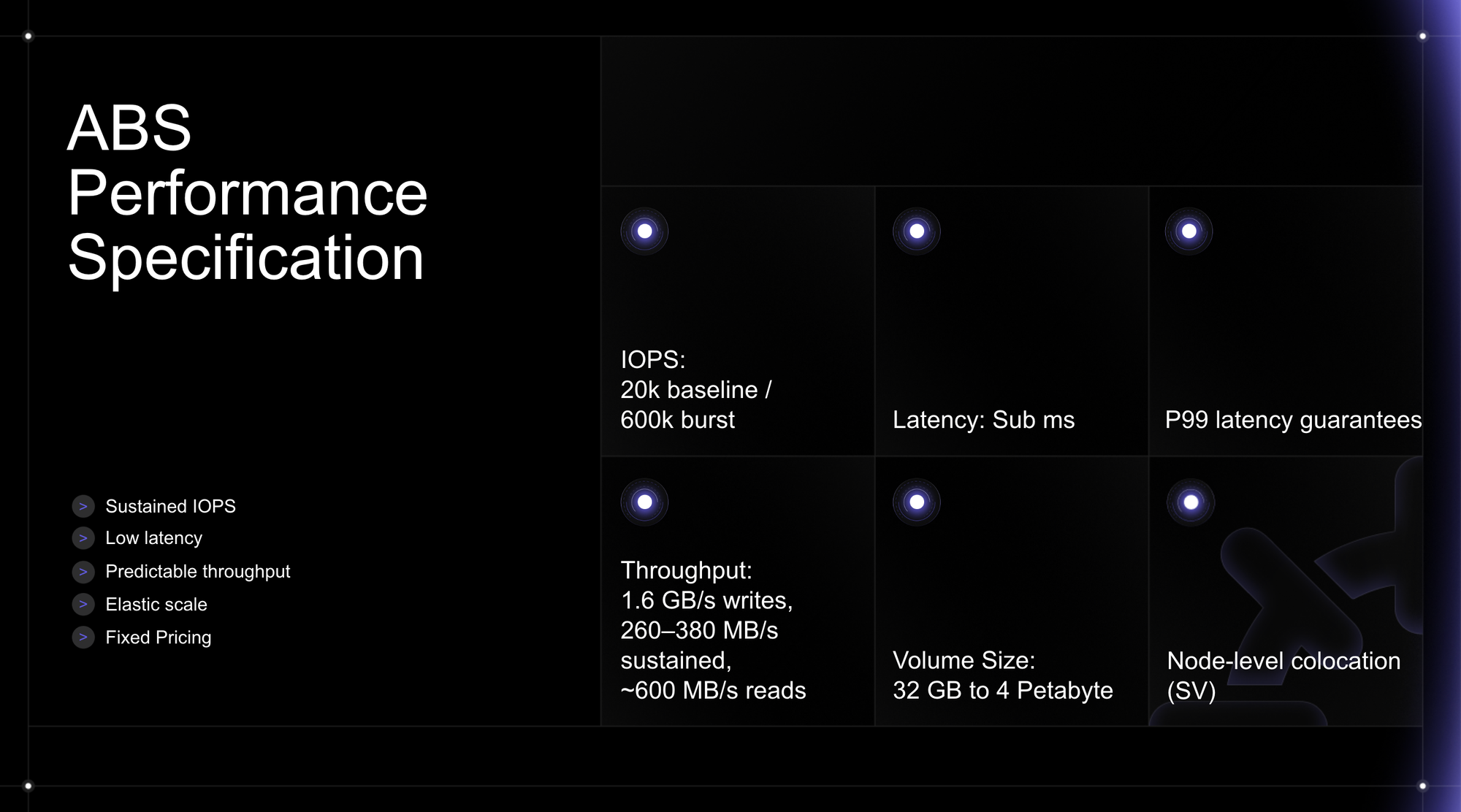
- Sustained IOPS: 20,000 baseline, up to 600,000 burst
- Latency: ~0.3 to 1.5 ms
- Throughput: High sustained read/write performance
- Consistency: No performance cliffs or throttling
- Benchmark-backed: Tested across real workloads on ClickBench and FIO: 10–14× faster than gp3 · io2-class performance · ~8× cheaper. See Benchmarking Report Summary.
The Challenge: Modern Workloads Don’t Cool Down
Traditional cloud infrastructure was designed for bursty workloads. Systems spike, then idle. Performance is shared, metered, and often tied to time-based limits.
Modern workloads don’t behave this way.
Real-time analytics, AI systems, databases, and data pipelines run continuously. They require consistent performance over time, not temporary bursts.
When traditional storage is pushed into this environment, performance degrades. Throughput becomes inconsistent. Latency increases. Not because demand changes, but because the system was never designed for sustained execution.
ABS is built for this reality by default.
What is Accelerated Block Storage (ABS)?
ABS is a high-performance block storage layer that stays fast under continuous load.
It delivers sustained IOPS through a storage architecture decoupled from compute, while remaining tightly integrated with Nirvana’s high clock-speed compute and private networking.
The result is predictable, low-latency storage that scales with your workload without degradation.
1. Sustained Performance, Not Bursts
Most storage systems perform well briefly, then degrade as load continues. Queues build up, latency increases, and throughput drops.
ABS is designed to stay fast over time.
- 20K baseline IOPS available by default
- Up to 600K burst capacity
- High sustained throughput across read and write
- No burst credits or time-based throttling
Performance doesn’t depend on timing. It’s there when you need it.
2. Built to Scale with Data
Modern systems generate and process large volumes of data continuously. Storage should scale without forcing architectural changes.
ABS scales from small deployments to multi-petabyte workloads without downtime or reconfiguration.
It supports databases, analytics engines, and high-throughput pipelines without introducing bottlenecks as data grows.
3. Predictable Cost, Predictable Performance
In most cloud environments, performance is something you provision and pay extra for.
IOPS, throughput, and consistency are gated behind configuration and pricing tiers.
ABS includes performance by default.
- Flat, storage-based pricing
- No IOPS add-ons
- No throughput metering
- No performance degradation over time
You get consistent performance without needing to constantly tune or manage it.
4. High Availability by Design
ABS is built as a highly available, decoupled storage layer.
Data is not tied to a single machine. Workloads can move, scale, or recover without requiring rebuilds or data migration.
This removes single points of failure and enables consistent performance across deployments.
Benchmarking: Performance That Holds Under Load
To validate performance, we benchmarked ABS against traditional cloud storage across both real-world and synthetic workloads.
Instead of relying on peak numbers, the testing focused on how systems behave under sustained pressure:
- Analytical queries with cold reads (ClickBench)
- Mixed read/write workloads (FIO)
- Different I/O sizes and continuous load scenarios
The results are consistent:
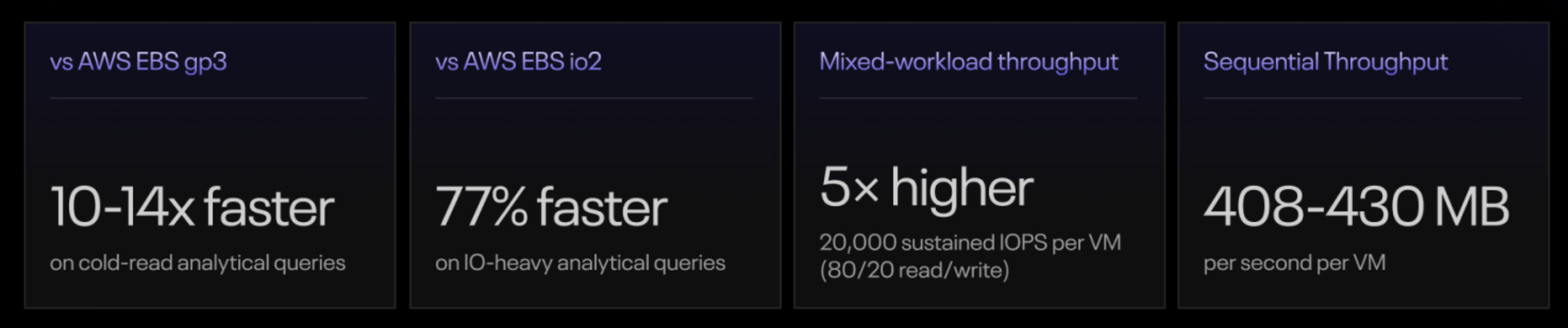
- ~10–14× faster than gp3 on cold-read workloads
- io2-class performance across the majority of queries
- Strong performance under mixed I/O (not just ideal conditions)
- Predictable throughput and latency over time
Most importantly, performance holds under sustained load, not just in short bursts.
Performance per Dollar
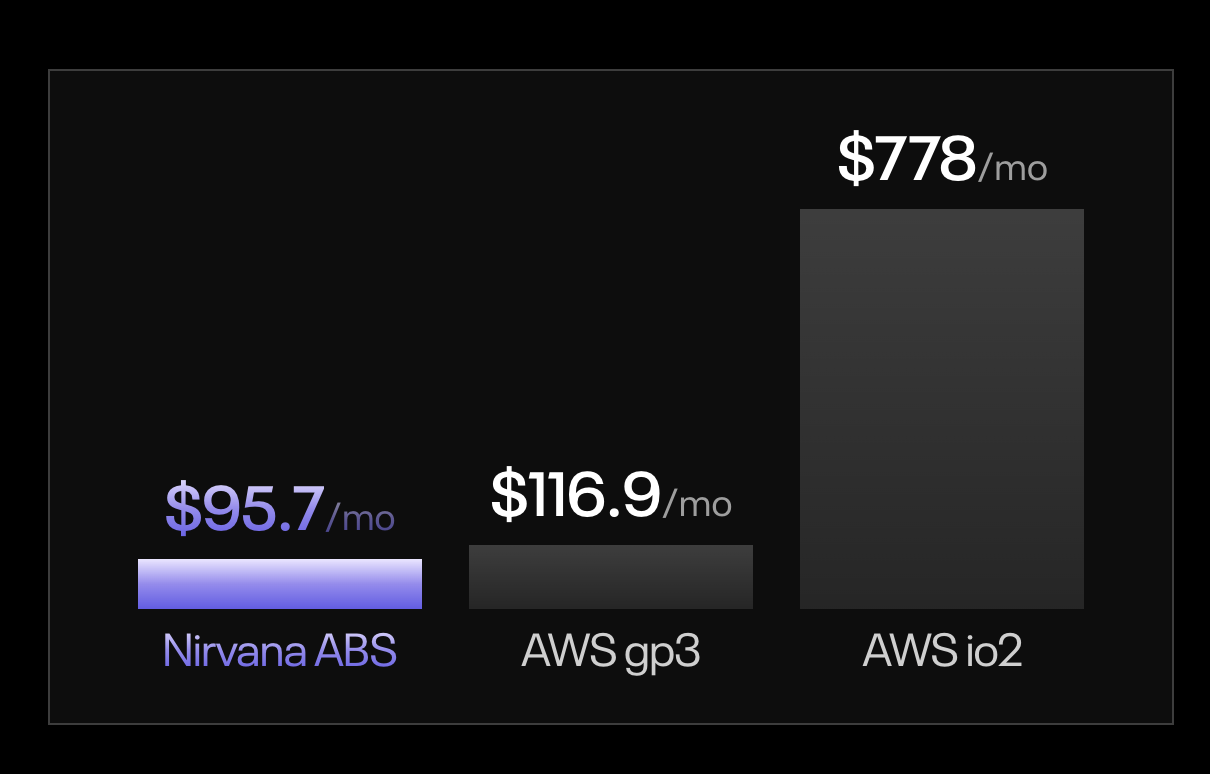
Under a normalized workload (1 TB storage, ~10K sustained IOPS):
- ABS delivers ~18% lower cost than gp3
- ~8× lower cost than io2, while achieving similar performance behavior
With performance included by default, ABS removes the need to trade cost for consistency.
Check out Pricing Calculator.
Rebuilding the Cloud for Modern Workloads
Modern workloads require infrastructure that is fast by default, not conditionally fast.
ABS is part of a broader effort to rebuild the cloud from the ground up, removing latency across compute, storage, and networking.
No burst mechanics. No hidden limits. No performance cliffs.
Just consistent, high-performance storage designed for systems that run continuously.
ABS is live.
If you’re running real-time, latency-sensitive, or data-intensive workloads, this is storage built to keep up.
👉 Learn more at Nirvana Labs
Modern Cloud for Real-time Workloads
High Clock Speeds Compute. Low latency Storage. Radically Cheaper Bandwidth.
Powering Web3, AI, and real-time systems.
Learn more at Nirvana Labs
Nirvana Cloud| Pricing | Blog | Docs | Twitter | Telegram | LinkedIn