Bare Metal vs Nirvana Labs
Bare Metal vs Nirvana Labs Performance and Tradeoff Comparison

Performance and Tradeoff Comparison
TL;DR
| Aspect | Bare Metal | Nirvana |
|---|---|---|
| Performance | Maximum single-node performance with low and predictable latency | Bare metal performance with storage, networking, and orchestration built around it |
| Provisioning | Provisioning new hardware takes time and follows hardware buying cycles | Infrastructure can be provisioned without managing hardware directly |
| Scaling | Scaling means adding more machines | Infrastructure designed to run systems without managing physical servers |
| Failure & Recovery | Node state is tied to the machine. Recovery depends on physical repair and restore | Snapshot before upgrading and attach the volume to new hardware if needed |
| Operations | Teams buy or rent servers and manage the complexity themselves | Nirvana integrates hardware and software into a system designed for Web3 workloads |
Summary:
Bare metal gives you a fast server. Nirvana gives you a fast system that can scale, recover, and upgrade safely and easily.
Bare metal has long been the gold standard for performance, full control, no virtualization overhead, no noisy neighbors, and strong isolation. Because of this, more high-performance blockchain nodes, indexers, and latency-sensitive trading systems have started to rely on bare metal today.
That choice makes sense. But there is also a bit of irony in it. Teams moved to the cloud to avoid managing hardware, and now many Web3 systems are back to running physical servers again.
When is this cycle gonna end? And which one should I choose? Here’s our take.
What Is Bare Metal?
Bare metal means running workloads directly on a single physical machine with no shared tenants. You get dedicated hardware where CPU, memory, and storage are tightly coupled to one machine, with no virtualization layer in between.
This model gives teams full control over hardware configuration, strong isolation, and maximum single-node performance with low and predictable latency. Those same strengths also come with very real tradeoffs.
Provisioning new hardware takes time and follows hardware buying cycles. Changing capacity often requires migrations or rebuilds. Scaling means adding more machines, not elastic resources.
Today, teams either buy and run their own bare metal or rent servers from bare-metal providers. In both cases, they still manage the complexity themselves.
Bare Metal vs Nirvana
Nirvana starts with bare metal, but builds a system around it.
Instead of handing teams raw servers, Nirvana rebuilds the cloud from the metal up, integrating dedicated hardware and software with storage, networking, and orchestration designed specifically for Web3 workloads.
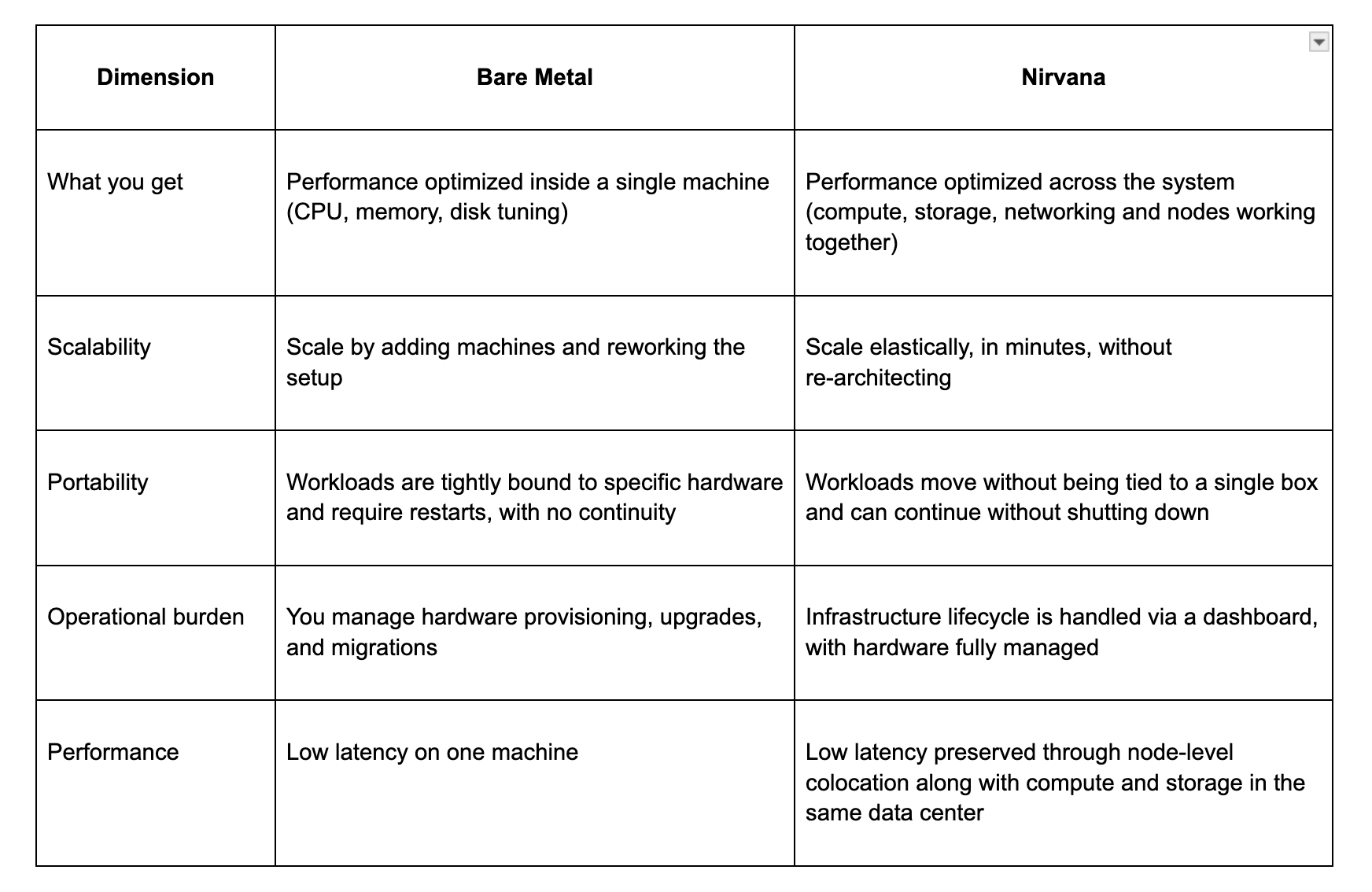
Comparison
Storage Highlight : Bare Metal (Local NVMe) vs Nirvana (ABS)
Blockchain storage never stops growing. Raw NVMe may be fast, but speed alone does not protect you from downtime, corruption, or operational risk.
Here is what actually happens in production.
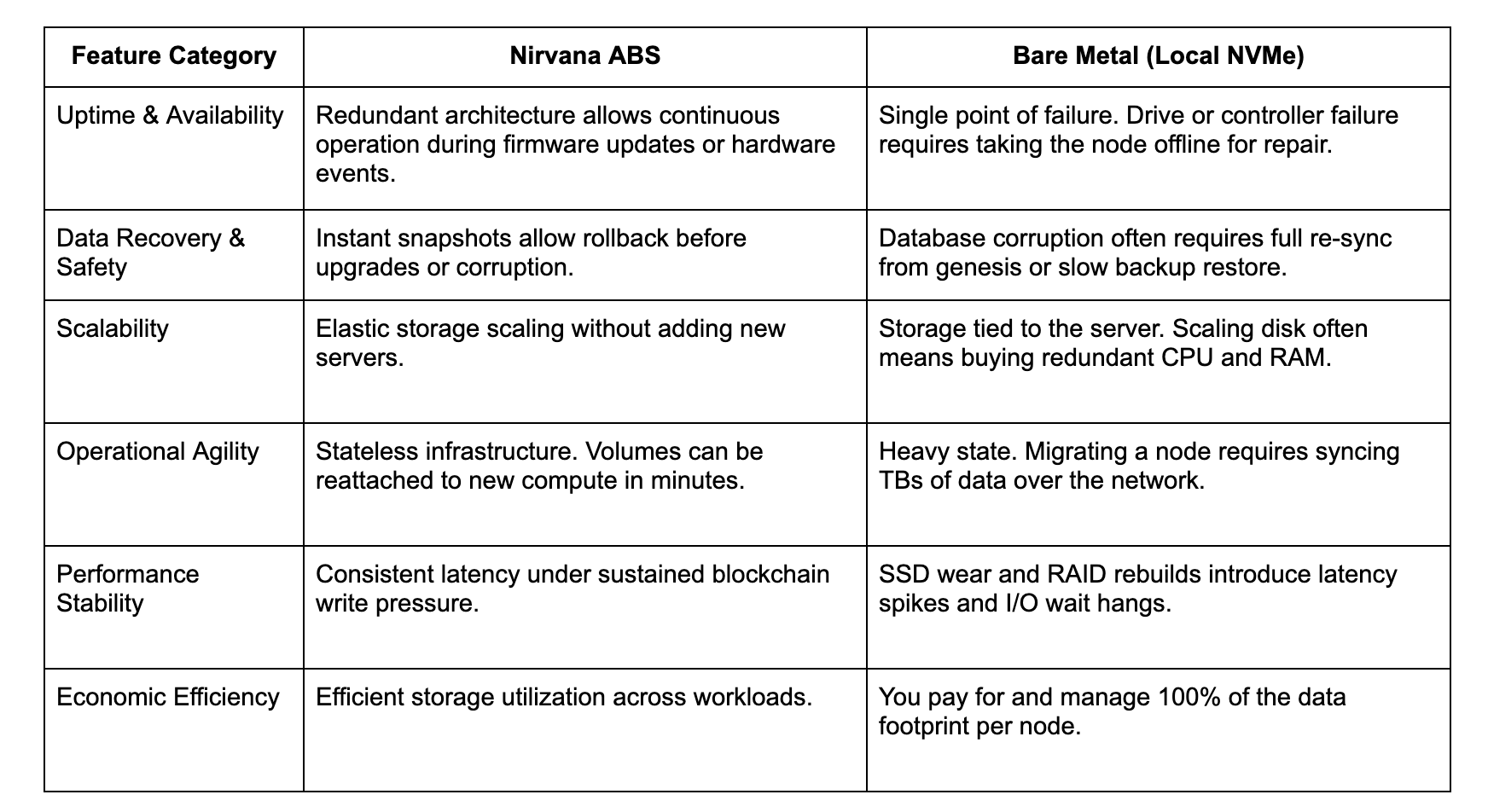
Given the differences above, certain failure modes commonly appear in production blockchain infrastructure.
Upgrade Risk
Client upgrades frequently involve database migrations.
On bare metal, a failed migration can mean days of re-sync.
With ABS, snapshot before upgrading and roll back instantly if needed.
Validator Risk
Latency spikes caused by SSD wear or RAID rebuilds can lead to missed attestations or penalties.
ABS isolates storage workloads and maintains consistent latency.
Hardware Failure
On bare metal, node state is trapped on the machine. If hardware fails, recovery depends on physical repair and restore.
With ABS, compute is stateless. Attach the volume to new hardware and continue.
Web3 infrastructure at scale
Bare metal optimizes a machine. Hyperscalers provide convenience, but often add layers of abstraction and unpredictable costs.
Nirvana takes a different approach. It combines the performance of bare metal with infrastructure designed to run large-scale systems without the operational burden of managing hardware.
We have tested performance extensively. ABS delivers sub-millisecond latency, on par with io2-class storage, while being up to 90% more cost-efficient, making it ideal for archive nodes, high-throughput RPC fleets, indexers, rollup sequencers, and trading infrastructure.
If you're evaluating alternatives to hyperscalers or managing your own bare metal, Nirvana offers a simpler path to high-performance infrastructure.
Want to learn more? Get in touch.
Nirvana: Modern Cloud for Real-time Workloads
High Clock Speeds Compute. Low latency Storage. Radically Cheaper Bandwidth.
Powering Web3, AI, and real-time systems.
Learn more at Nirvana Labs
Nirvana Cloud| Pricing | Blog | Docs | Twitter | Telegram | LinkedIn